Sensations English
  • Lesson
  • Activities and Tools
Vocabulary and Grammar

Verben

Lies die fünf Sätze. Wähle das richtige Verb.

  • Verben zum Vervollständigen von Sätzen korrekt verwenden können
  • Das passende Verb aus einer Reihe von Vorgaben auswählen können
Was lerne ich? +
Wähle deine Sprachniveau aus:
A2 Grundlegende Sprachkenntnisse B1 Erweiterte Sprachkenntnisse B1+ Gute Sprachkenntnisse B2 Fortgeschrittene Sprachkenntnisse C1 Fließende Sprachverwendung Stufen
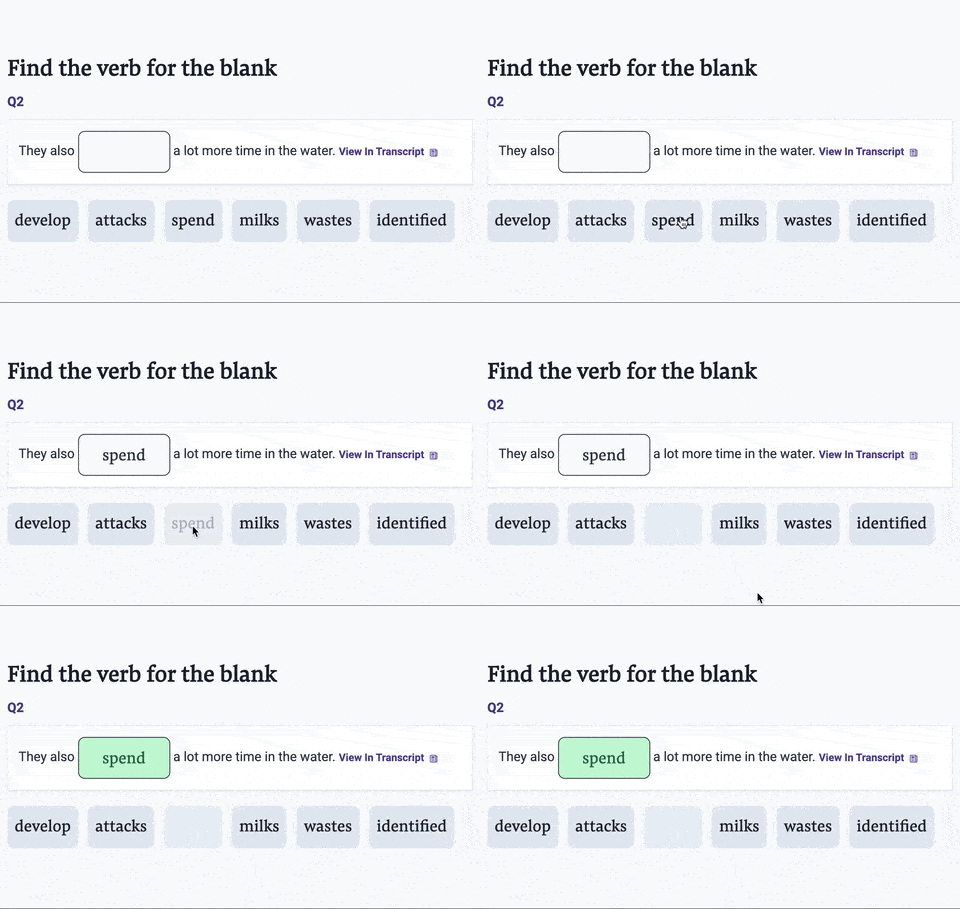
Image from this game
© Eduflat & Lernserver
Fetching... Play Game at B1+
Start Again
Scroll to view more options
You are correct!

Congrats - you are smashing this

Incorrect. The answer is:

Not quite right, try the next question.

close
transcript
Study finds links in dinosaur anatomy - 1st June 2026
New scientific research has found an explanation for Tyrannosaurus rex's tiny arms. The study was a joint effort by scientists from the University of Cambridge and University College London.
The gigantic T. rex, which lived between 68 and 66 million years ago, measured up to 13 metres in length and could be 4 metres tall. However, its front limbs weren't even a metre long.
Over the years, there have been many attempts to explain their shortness. T. rex might have used them to keep hold of the animals that it ate. Another theory is that they were used to attract a mate.
The research, which was by palaeontologists Charlie Roger Scherer, Paul Upchurch and Elizabeth Steell, studied 85 species. They found that these meat-eating dinosaurs from 5 different lineages all had something in common. The larger the animals they ate, the smaller their arms.
Instead, these huge dinosaurs used their heads to attack their prey. As their skulls were more powerful than their arms, they evolved to be stronger - and their forelimbs shrank. It's a "use it or lose it" scenario, explains Scherer.
The researchers have invented a new way of measuring dinosaur skulls. This allowed them to compare each skull's strength and identified that T. rex had the strongest skull. Tyrannotitan, which lived 30 million years before T. rex, had the second strongest.
This method also identified a clear relationship between dinosaurs having stronger skulls and smaller arms. However, it couldn't say what purpose they had. Scherer's optimistic, stating, "Hopefully, we can find that out with a bit more work."
Scroll to view more options
ACTIVITY COMPLETE

You scored

Brilliant, you’re really proficient! You’ll find the C1 level really helpful to maintain your high standard of English.

Repeat activity

More games

Next
Previous
JETZT UNVERBINDLICH SICHTEN

Sie erhalten Zugriff auf 3 Videos und/oder Artikel pro Tag sowie auf alle Übungen und Lerntools.

Registrieren Sie sich hier mit Ihrer E-Mail-Adresse.
Mit der Registrierung stimmen Sie unseren Nutzungsbedingungen und der Datenschutzerklärung zu.
Sie haben bereits ein Konto? Anmelden

Sign up with email

Enter the following information to create your account.
All sign up options

Log in Or create an account

log in via email
or

Forgot password?

all sign up options

reset password or login

Crop Image

Add to homescreen