Sensations English
  • Lesson
  • Activities and Tools
Reading

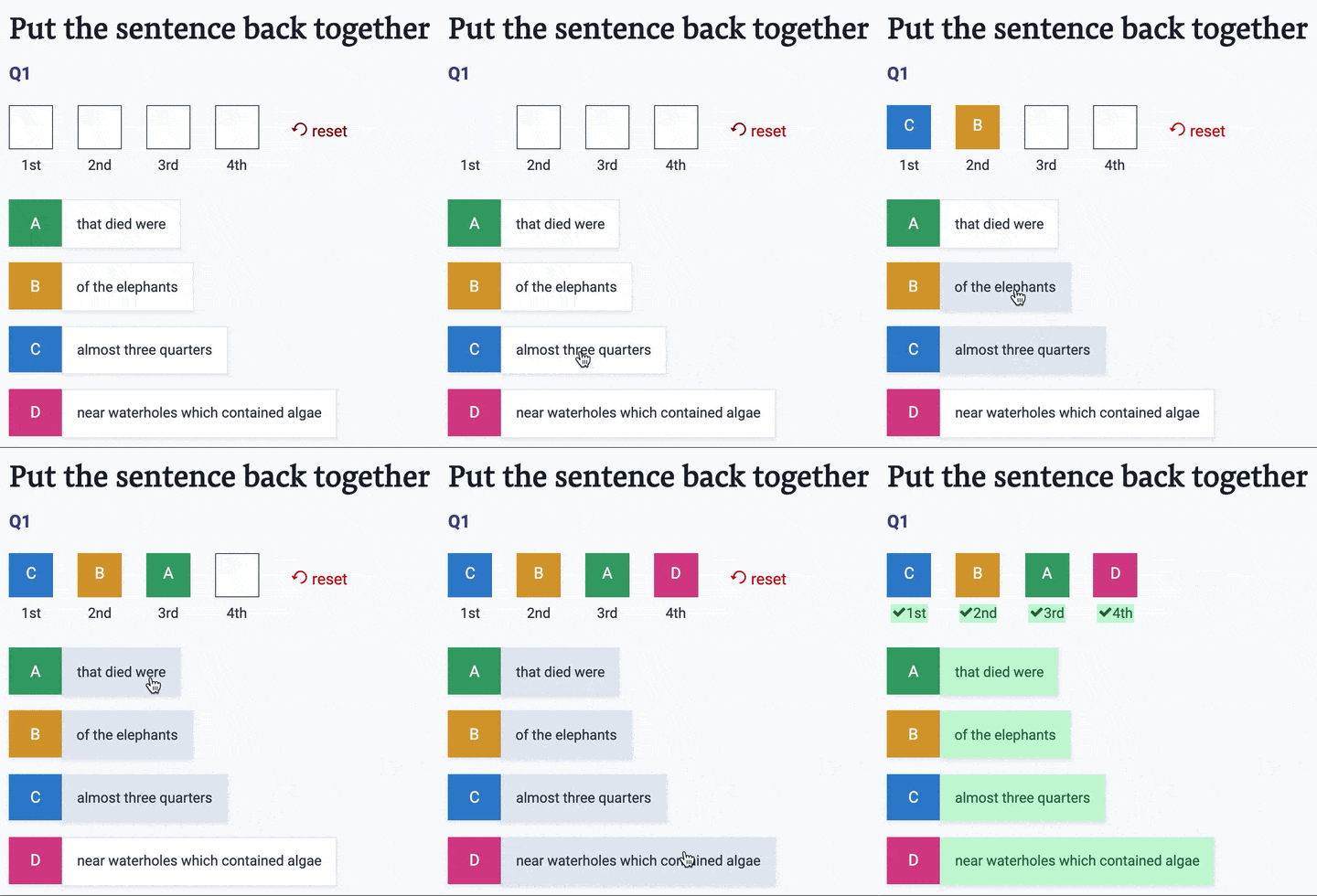
Setze den Satz wieder zusammen

Bringe die Satzteile in die richtige Reihenfolge. Jeder Satz besteht aus vier Teilen. Es gibt bis zu fünf Fragen.

  • Sätze in die korrekte Reihenfolge bringen können
  • Grammatikstrukturen in einem Satz erkennen können
  • Wortverbindungen und Wortfelder erkennen können
Was lerne ich? +
Wähle deine Sprachniveau aus:
A2 Grundlegende Sprachkenntnisse B1 Erweiterte Sprachkenntnisse B1+ Gute Sprachkenntnisse B2 Fortgeschrittene Sprachkenntnisse C1 Fließende Sprachverwendung Stufen
Image from this game
© Eduflat & Lernserver
Fetching... Play Game at B2
Start Again
Scroll to view more options
You are correct!

Congrats - you are smashing this

Incorrect. The answer is:

Not quite right, try the next question.

close
transcript
Study finds links in dinosaur anatomy - 1st June 2026
The riddle of why Tyrannosaurus rex's forelimbs appear to be so out of proportion may have been solved by researchers from the University of Cambridge and University College London. Their latest research shines light on an often-arbitrary debate.
A bipedal carnivore with a body up to 13 metres long, T. rex measured almost four metres tall up to the hip. Despite having forelimbs less than a metre long, this fearsome predator stalked the Earth from 68 to 66 million years ago.
Multiple theories have attempted to account for this anomaly, including that T. rex used them to grip its prey. One suggests they play a role in courtship rituals, while another imagines their length stopped them being bitten off by another T. rex.
This research broadened out the question to 85 different species of carnivorous dinosaur. Its authors, Charlie Roger Scherer, Paul Upchurch and Elizabeth Steell, catalogued forelimb length in theropods from 5 diverse lineages and identified a common thread.
The dinosaurs catching the largest prey consistently had shortened forelimbs, since attacking them with their heads was more effective. Therefore, the strength of the predator's skull mattered more than its upper limbs. For Scherer, evolution takes a simple "use it or lose it" approach.
The team compared species' skulls, developing a new method for quantifying 'cranial robusticity'. They graded skull size, bite force and how the bones fitted together. This placed each species on the same scale, with T. rex scoring the highest. Tyrannotitan, a dinosaur from 30 million years earlier, took second place.
The study revealed high cranial robusticity consistently aligned with having shorter forelimbs. This pattern crossed theropod lineages over 180 million years. The result brings uncovering these forelimbs' purpose a step closer. Scherer believes "They obviously served some sort of function, otherwise they wouldn't have them. ... Hopefully, we can find that out with a bit more work."
Scroll to view more options
ACTIVITY COMPLETE

You scored

Brilliant, you’re really proficient! You’ll find the C1 level really helpful to maintain your high standard of English.

Repeat activity

More games

Next
Previous
JETZT UNVERBINDLICH SICHTEN

Sie erhalten Zugriff auf 3 Videos und/oder Artikel pro Tag sowie auf alle Übungen und Lerntools.

Registrieren Sie sich hier mit Ihrer E-Mail-Adresse.
Mit der Registrierung stimmen Sie unseren Nutzungsbedingungen und der Datenschutzerklärung zu.
Sie haben bereits ein Konto? Anmelden

Sign up with email

Enter the following information to create your account.
All sign up options

Log in Or create an account

log in via email
or

Forgot password?

all sign up options

reset password or login

Crop Image

Add to homescreen